-
关注Ta
-
- 注册时间 2008-06-08
- 最后登录 2026-09-18
- 在线时间2249小时
-
- 发帖4437
- 搜Ta的帖子
- 精华0
- 派派币9417
- 威望1888
- 鲜花15905
- 鸡蛋21
- 在线时间2249 小时
-
访问空间加好友用道具

当华美的叶片落尽,生命的脉络才历历可见..
|
How the Beatles Went Viral: Blunders, Technology & Luck Broke the Fab Four in America
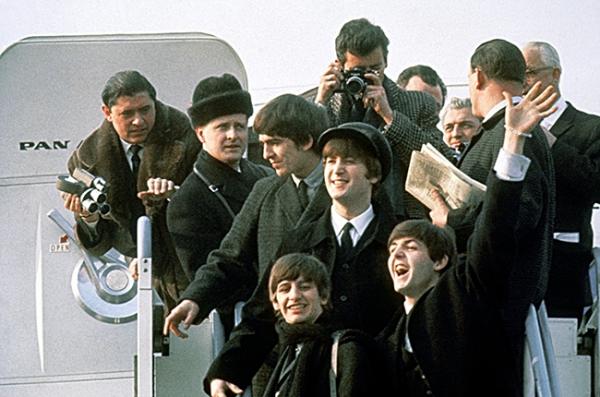
Six weeks is all it took for the Liverpool foursome to go from unknowns to the biggest pop stars in the USA. Here's an exhaustive look at how it happened
Consider the following: At the end of 1963, virtually no one in America had heard of the Beatles. Yet on Feb. 9, 1964, they drew the largest TV audience in history-73 million viewers-when they appeared on "The Ed Sullivan Show." How could such a conquest have occurred so quickly? I once asked my friend Lenny Kaye that question, and he answered: "Everybody was ready for the '60s to begin." There's some truth to that, but of course there's much more to the story. The explosion of the Beatles in America was the result of combined forces-artistic, social and technological-as well as persistence, showbiz rivalries and more than a bit of luck. So how did it happen that the Beatles came out of nowhere to become the biggest cultural sensation ever, in six weeks?
FAB AT 50: THE BEATLES ON THE COVER OF THE JAN. 11, 2014 BILLBOARD
• Subscribe • BUY THIS ISSUE • Billboard on iPad
Of course the Beatles didn't really come out of nowhere. They came out of England. And England was where the frenzy that was Beatlemania began. Unlike its blitzkrieg-like arrival in America, Britain's obsession with the Beatles emerged during the course of nearly a year. The band was huge locally in its native Liverpool, even before the group had begun to make records. After the Beatles signed to EMI's Parlophone label, a series of singles appeared beginning in late 1962: "Love Me Do," "Please Please Me" and "From Me to You"-each a bigger hit than the previous one. The first whispers of mass hysteria wafted out of the north of England in late spring, just as Please Please Me moved into the No. 1 position on the U.K. chart, a spot that a succession of Beatles albums would hold for almost a year.
With the Beatles touring relentlessly, the screaming girls, the frenzied chase scenes, the whole carnival spread steadily, town by town. In late August, the band released its biggest hit yet-"She Loves You," which became the all-time best-selling single by a U.K. act.
Pop hadn't been a subject to which the major newspapers paid much attention. In fact, it took John Lennon's involvement in a fistfight at a birthday party for Paul McCartney in June to garner the band its first national headline: "Beatle In Brawl-Sorry I Socked You" read the back page banner of the Daily Mirror.
But by late summer of 1963, the press couldn't have been more eager for the story of four young outsiders from the hinterlands who had the power to arouse young British womanhood to heights of hysteria. In the wake of the Profumo sex scandal (at that moment in the midst of bringing down the government) and concurrent revelations of outrageous sexual escapades involving Britain's upper crust, the U.K. press were newly fascinated by, and emboldened in covering, sexually charged topics. This new raciness, the precursor to Britain's subsequent sex-crazed tabloid press, found an eager audience with the British public. The Times of London opined: "On the island where the subject has long been taboo in polite society, sex has exploded into the national consciousness and national headlines." Stories about the Beatles craze, a phenomenon viewed as overtly sexual (and rightly so), became a daily presence in the tabloids.
The Beatles' 50 Biggest Billboard Hits
At first, the press took a bemused stance. In September, the Daily Mirror ran a story about the Beatles headlined "Four Frenzied Little Lord Fauntleroys." But then, on Oct. 13, the frenzy hit London itself: The Beatles appeared that evening on Val Parnell's "Sunday Night at the London Palladium," the biggest TV variety show in the country, and thousands of screaming fans descended on the venue, closing off streets and clashing with the police for hours. Coincidentally, on that same day the Daily Mirror coined the term "Beatlemania" to describe a similar scene at the band's concert the previous day in Cheltenham. (The term itself was a play on Lisztomania, the 1840s frenzy that had accompanied the concerts of Franz Liszt.) It wasn't long before the more serious broadsheets were weighing in with pseudo-psychological analyses. The Sunday Times of London got straight to the point, quoting a young girl who answered a BBC interviewer's question regarding why she screamed at the mere mention of the group by confessing, "It's not something I could say on the radio."
CAPITOL TO THE BEATLES: 'DEAD IN THE WATER'
Meanwhile, America was oblivious to what was transpiring across the ocean. Throughout 1963, Capitol Records, which as a sister EMI-owned label held the U.S. rights to Parlophone's product, showed no interest in the band. This was largely due to the tastes of the man in charge of the label's international A&R, Dave Dexter, whose responsibilities included sifting through EMI's international product searching for potential U.S. hits. Capitol's track record in international A&R was quite good: In June 1963, for example, it released a record from EMI Japan titled "Sukiyaki" by Kyu Sakamoto that went to No. 1. But rock'n'roll was American music-Capitol already had the Beach Boys-and no English act had ever sustained a career as a U.S. hitmaker.
Besides, Dexter just didn't like rock. A 20-year veteran of the label who had joined Capitol shortly after it was founded, he'd condemned rock'n'roll as "juvenile and maddeningly repetitive" in an internal memo several years earlier, decrying a music biz increasingly driven by the tastes of children. Dexter's preferences ran toward jazz, and he'd had a good run signing Peggy Lee, Nat "King" Cole and Stan Kenton.
The first two No. 1 Beatles singles that Parlophone offered to Capitol, "Please Please Me" and "From Me to You," were turned down by Dexter and licensed instead to Chicago independent label Vee-Jay Records, whose attorney Paul Marshall happened to be EMI's U.S. attorney as well. Vee-Jay might have been a good home for the Beatles, as it was having considerable success at the time with the Four Seasons, another Marshall client. But by early 1963, the label was short of funds due to its president, Ewart Abner, having dug into Vee-Jay's operating budget in order to cover personal Las Vegas gambling losses.
Upon Vee-Jay's February 1963 release of "Please Please Me," Dick Biondi-a DJ at top 40 WLS Chicago and a friend of Abner's-became the first DJ to play a Beatles record in the United States. Due primarily to airplay on Biondi's show, the song (mistakenly credited to "The Beattles" on the 45 label and in trade ads) made it to No. 35 at WLS in March, although it didn't chart nationally.
By late May, when Vee-Jay released the Beatles' next single, "From Me to You," Biondi had been fired by WLS. He was back on-air a month later at KRLA Los Angeles. Although no longer working in Vee-Jay's hometown, he continued to be supportive of the label's Beatles releases, and by the end of June convinced KRLA to add "From Me to You" to its playlist, even though the record hadn't gotten any national traction in the month since its release. The song charted for six weeks on KRLA's survey in July and August, peaking at No. 33, which was enough to crack Billboard's Bubbling Under Singles chart, where it reached No. 116. Still, it had sold fewer than 15,000 singles by the end of 1963.
50 Years Ago: The Beatles First Hot 100 Chart Appearance
Faring slightly better with "From Me to You" was American rocker Del Shannon, who had toured with the Beatles in England that spring. Shannon's version spent four weeks on the Billboard Hot 100, peaking at No. 77 in July and marking the first appearance of a Lennon-McCartney song on the Hot 100. Shannon's cover may have eliminated any chance of the Beatles' original spreading nationally off of Biondi's support. A letter from the PD of KXOK St. Louis to George Â-Harrison's sister Louise-who lived in Benton, Ill., and had been trying to drum up support for her brother's band-cited the station's earlier support for Shannon's single as reason for not playing the Beatles' version.
Meanwhile, Abner was dismissed from his post at Vee-Jay when his malfeasance was discovered. This aroused the suspicion of Marshall, who quit as Vee-Jay's attorney, opting to cast his lot with EMI. In August Marshall, acting on behalf of EMI's U.S. licensing agent Transglobal, accused Vee-Jay of non-payment of royalties, ordered Vee-Jay to cease and desist in distributing the Beatles' music and revoked the label's options for future singles. Total royalties owed on Beatles sales at that point were less than $1,000, but Vee-Jay wasn't particularly bothered about losing the unsuccessful band. The label was far more concerned with Marshall's efforts to get the Four Seasons out of their Vee-Jay contract, also for failure to pay royalties, which he successfully did.
At the same time, "She Loves You" was beginning its record-breaking asÂ-cent on the U.K. chart and, having canceled the Vee-Jay deal, Marshall approached Dave Dexter at Capitol with the hot new single. In spite of British buzz growing to deafening levels, Dexter turned down the Beatles yet again, reasoning that the Vee-Jay flops proved he was right to have passed on them in the first place. "Dead in the water" was how he described the band's U.S. prospects.
Transglobal licensed "She Loves You" to a tiny indie, Swan Records of Philadelphia, which released it stateside on Sept. 16. Swan had even less success with the Beatles than Vee-Jay: The song failed to chart at any station, and was roundly rejected by audiences when it was played at all. DJ Murray the K at WINS New York spun "She Loves You" on Sept. 28 in a five-way "battle of the hits," where it came in third. He continued to play it every night for a week solid, but got no reaction. Swan convinced "American Bandstand," which broadcast from the label's hometown, to play the song in its "Rate a Record" segment, where it received a score of 73 out of 100. Worse, the teens on "Bandstand" laughed when host Dick Clark held up a photo of the moptopped Beatles. After that incident, Clark recalled, "I figured these guys were going nowhere."
On the same September day that Swan released "She Loves You," Harrison came to the States to visit his sister in Illinois, where he remained totally anonymous. Louise took her brother to a radio station in West Frankfurt, Ill., that had played "From Me to You" at her urging. The station spun a copy of "She Loves You" that Harrison had brought with him, and he was interviewed on-air by the 17-year-old daughter of the station owner, all to no discernible listener response. And when Harrison jammed with a local band called the Four Vests, playing '50s rock songs at a dance, no one even thought to ask for his autograph. (Perhaps the most productive thing he did while in Illinois was purchase an album by R&B artist James Ray, which included "Got My Mind Set on You." Harrison's cover of the song would become the last No. 1 Hot 100 hit to date by any Beatle when it topped the summit nearly 25 years later.) Harrison returned to England feeling despondent about the Beatles' chances in America.
WINNING OVER THE ROYALS, AND ED SULLIVAN
After the band's performance on "Sunday Night at the London Palladium" on Oct. 13, the tabloid press hysteria in the United Kingdom reached a fever pitch, and the American press began to take notice. On Oct. 29, the Washington Post published the first U.S. story on the phenomenon, written by London correspondent Flora Lewis. Titled "Thousands Of Britons 'Riot,'" the story reported on the need for riot squads to calm the crowds in four British cities where the band had recently played. Lewis' article was dismissive of the music (declaring that the beat was the same "over and over"), and she compared the Beatles' look to "limp, upside-down dust mops."
Britain got a respite from the madness for a few days in late October while the band toured Sweden. Upon their return on Oct. 31, the Beatles were met at a rainy London Airport by more than 1,000 screaming fans. The New York Times reported that even the sound of the taxiing jets was no match for the screams of the crowd. Ed Sullivan, also at London Airport that day, assumed the ruckus was for a member of the British Royal Family. When informed it was for the Beatles, he asked, "Who the hell are the Beatles?" Sullivan, a former gossip columnist, had a nose for a good story and something about the scene reminded him of the early days of Elvis Presley, whom he had famously presented on his variety show years earlier. He began to contemplate booking the Beatles, perhaps as a novelty act.
On Nov. 4, the Beatles performed as part of the Royal Variety Performance at the London Palladium. In the British press, it was the moment they morphed from the objects of a barbarous throng's coarse obsession into lovable moptops. As with all acts on the bill at the annual charity event, the Beatles performed at the invitation of Queen Elizabeth, although the Queen herself stayed home that evening, pregnant with Prince Edward. The Queen Mother, best-loved of the Royal Family, was in attendance, however, and was reported to have been clapping along on the off beat during the Beatles' set, while Princess Margaret snapped her fingers.
Famously, Lennon introduced the band's finale that evening, "Twist and Shout," with the quip, "Will the people in the cheaper seats clap your hands? And the rest of you, if you'll just rattle your jewelry." It was a display of cheekiness that heretofore one simply didn't exhibit before the Royal Family. And yet, by narrowing the distance between the monarchy and the working-class foursome onstage, Lennon brought down the house-and in the process managed to make the band all the more beloved in an England where notions of one's proper place were evolving rapidly. Even the Queen Mother came away a fan, calling the Beatles "so young, fresh and vital."
From then on, the Beatles were treated as something akin to national heroes. While the Nov. 2 Daily Telegraph had compared a Beatles concert to Hitler's Nuremberg rallies, the morning after the Royal Variety Performance the band achieved a new legitimacy from a love-struck press. As the Daily Mirror put it, "You have to be a real square not to love the nutty, noisy, happy, handsome Beatles." Victory was total: By December, London Sunday Times music critic Richard Buckle was comparing their music to Beethoven.
Despite the undeniable phenomenon of the Beatles in England-which was growing by the day-Capitol U.S. dealt yet another blow to the band in early November when Dexter again turned down its latest single. This one, "I Want to Hold Your Hand," had advance orders in the United Kingdom of more than 1 million singles. The day after the Royal Variety Performance, the band's manager Brian Epstein headed to New York. Ostensibly the trip was to promote one of his other acts, Liverpool singer Billy J. Kramer, who was signed to Liberty Records and who accompanied him on the journey. But more importantly, Epstein was determined to figure out how to get the Beatles' U.S. career on track.
Part of Epstein's efforts in New York would focus on securing the Beatles a spot on "The Ed Sullivan Show." Sullivan's European scout, Peter Pritchard, had taken the show's talent coordinator Bob Babb to see the band perform earlier in the year and was regularly updating Babb on the group's progress. Pritchard called Sullivan and encouraged him to meet with Epstein. The reception the band had received at London Airport was intriguing, but it was Pritchard's report of how the group wowed the Royal Family that made Sullivan agree to a sit-down with Epstein.
After two meetings, the deal was set: The Beatles would appear on two episodes of "The Ed Sullivan Show" on Feb. 9 and Feb. 16, and a third appearance would be taped for broadcast at a later date. (The three episodes would ultimately be broadcast on consecutive weeks.) Sullivan had done something similar with Presley in 1956, when he booked the singer for three appearances in a four-month period. But the Beatles were flying in from England, and the time frame for their appearances was condensed to avoid the expense of repeatedly flying them in and out.
Sullivan had quite a reputation for being budget-conscious, but in the case of the Beatles he was particularly parsimonious. While performers on his show regularly received $10,000 or more for a top-billed appearance-a red-hot Presley had received $50,000 in 1956 for his three appearances-Sullivan held the upper hand in his negotiations with Epstein, who represented a group unknown in America. Thus, Epstein settled for $10,000 total for the three appearances. But he'd gotten what he wanted: a top-billed performance on "The Ed Sullivan Show," plus two more. For an unproven act, such a commitment from Sullivan was unprecedented, but, as Sullivan later recalled in a New York Times interview, "I made up my mind that this was the same sort of mass hysteria that had characterized the Elvis Presley days."
Sixteen seasons into his unparalleled 23-year prime-time run on CBS, Sullivan was just now reaching the zenith of his own fame and his show's star-making power. A few months earlier, he'd been lionized in the film version of the stage musical "Bye Bye Birdie," in which he played himself and which featured an eponymous musical number-performed cathedral-choir style-devoted to just how monumental it was to appear on the show: "Ed Sullivan," the choir sang. "We're going to be on Ed Sullivan!" A single appearance on the show could be a ticket to the top for a lucky performer. Getting three made Epstein feel like it was a lock.
THE U.S. MEDIA MEETS THE BEATLES
In the case of the Beatles, mere word of Sullivan's agreement to feature them on three episodes was enough to change the band's fortunes in America. With Sullivan booked, Epstein set out to address Capitol's indifference. While there is considerable debate about what happened next, it appears Epstein paid a visit to Capitol East Coast chief Brown Meggs to plead the band's case-and came away with a release commitment. Unknown to Epstein, EMI managing director L.G. Wood had already greased the skids for the band's U.S. release on Capitol after Dexter had passed for the fourth time. Wood, furious that Capitol wouldn't license the Beatles, flew to New York and met with Capitol president Alan Livingston, who was summoned from Los Angeles. Armed with a mandate from EMI chairman Joseph Lockwood to break the logjam, Wood demanded that Livingston agree to a Beatles release on Capitol.
Livingston was offended by EMI's demand, as the understanding with EMI was that Capitol would merely have the first right of refusal on EMI product, with no obligation to license. A highly successful record man whose prior accomplishments ranged from signing Frank Sinatra to creating Bozo the Clown (and who later in life would own the production company that signed Don McLean's "American Pie"), Livingston was used to running Capitol as his own fiefdom. But the truth was, EMI owned 96% of Capitol and Livingston was an employee. Wood refused to let Livingston leave the meeting until he'd agreed to a Beatles release. Livingston grudgingly agreed to press 5,000 copies of the next single. Only later, after word came in that Epstein had secured three appearances for the Beatles with Sullivan, did Capitol get onboard in a big way, committing to a $40,000 marketing budget (about $300,000 in today's dollars), a then-unprecedented sum for a new act.
The Beatles' 50 Biggest Billboard Hits
Livingston's version of the story differs entirely: In his recollection, he received a call in November from Epstein, who wanted to know why Capitol hadn't released any Beatles records. Livingston responded that he'd never heard a Beatles record, which seems implausible given that the band was, by this time, a bona fide phenomenon, to which Capitol held U.S. rights, and Livingston was in regular contact with Wood, who presumably had been encouraging him to release the group's records. That this decision would remain entirely in the hands of Dexter, with no oversight, in spite of all the mounting pressure, doesn't make sense. Livingston further contends that upon speaking with Epstein, he asked Dexter to bring him some Beatles records, and after hearing them he immediately sensed the band's U.S. potential and agreed to put them out with the $40,000 marketing budget.
(Amazingly, Dexter kept his post as head of international A&R in spite of having turned down not only the Beatles but also Gerry & the Pacemakers, the Hollies, the Animals, the Dave Clark Five, Herman's Hermits and the Yardbirds, not to mention Epstein's Billy J. Kramer. In fact, Dexter remained in charge of A&R'ing the Beatles' records for the American market and was responsible for the reconfiguration of the U.K. albums on Capitol. Years later, upon Lennon's death, he wrote a fairly mean editorial in Billboard about the late Beatle, for which the magazine later apologized.)
Epstein's New York visit was jam-packed, including an interview with the New Yorker that would be published the following month, visits to music publications, plus the Kramer promotion, which culminated in a TV performance of Kramer's cover of the Beatles' "Do You Want to Know a Secret" on "The Joe Franklin Show." But besides the Sullivan meetings, his most significant encounter was with General Artists Corp. agent Sid Bernstein, who was hell-bent on booking the still-unknown Beatles at New York's Carnegie Hall.
Bernstein had discovered the Beatles while taking an evening Western civilization course at the New School, in which one of the requirements was reading British newspapers to better understand the parliamentary system. As a booking agent by day, his eyes inevitably drifted to the entertainment pages, where the hysteria the Beatles were causing was mentioned with increasing frequency. He tracked down Epstein and in early autumn pitched his Carnegie Hall idea over the phone. Epstein was hesitant to commit to anything before the Beatles were famous in the States, out of fear of playing before an empty house. For its part, GAC was equally hesitant to book an unknown pop group.
Bernstein thus made the audacious offer to rent Carnegie Hall at his own expense, leaving out GAC, with a proposed concert date of Feb. 12. As fate would have it, that was when the Beatles were set to perform on "The Ed Sullivan Show." Bernstein was confident that with the Sullivan deal sealed, ticket sales would be assured. While Epstein didn't formally agree until after Jan. 1 to do the concert, Bernstein took their conversation as a yes and proceeded to rent Carnegie Hall. When the booker at Carnegie asked him what kind of an act the Beatles were, Bernstein, who knew that the venue didn't tend to book pop bands, replied, with more truth than he'd intended, "They're a phenomenon."
Simultaneously, the American media was becoming fascinated by Britain's fascination with the Beatles. Within the course of a week in mid-November, the band experienced intense U.S. press and TV attention: On Nov. 15, Time magazine published an account of "The New Madness," and Newsweek followed three days later with an article simply titled "Beatlemania." And all three U.S. TV networks sent camera crews to cover the Beatles' Nov. 16 concert in Bournemouth, which was marked by the usual clashes between fans and police.
Once again, timing worked to the Beatles' advantage: Just two months earlier, both CBS and NBC had expanded their evening news shows from 15 minutes to a half hour. This left them with airtime to fill, allowing for the kind of light features the evening news had never previously aired. NBC was first out of the gate, running a four-minute Beatlemania story on the top-rated "Huntley-Brinkley Report" on Nov. 18. Correspondent Edwin Â-Newman's piece was about fan hysteria, although he did include 30 seconds of the studio recording of "From Me to You," as well as a snippet of the live Bournemouth performance of the same song, which was nearly drowned out by audience screams. "One reason for the Beatles' popularity," Newman quipped, "is that it's almost impossible to hear them."
CBS' story followed on Nov. 22, the same day With the Beatles was released in England. (ABC, whose newscast still stood at 15 minutes, never aired its story.) As a teaser for the four-minute piece set to appear on Walter Cronkite's evening news show, an abbreviated version aired on "CBS Morning News" with Mike Wallace. But the full piece didn't run that evening. Instead, everything came to a standstill with the news that President John F. Kennedy had been assassinated.
A 15-YEAR-OLD GIRL SETS RADIO IN MOTION
The Kennedy assassination sent all of American society into a depressed stupor. And perhaps no societal group was more crushed than the nation's youth, for whom JFK embodied idealism and optimism. To be a young American right after the assassination was to be afflicted by shock, giving way to sadness and disillusionment.
The spell weighed heavily and cried out to be broken. But the top 40 airwaves were no place to find respite in the wake of the Â-assassination. By some strange coincidence, a folk ballad about the founder of a Roman Catholic religious order, sung in French, sat poised to ascend to No. 1 on the chart just as the nation's first Catholic president was killed. No song could have captured the nation's mood at that moment more precisely than "Dominique," written and recorded by the Belgian Sister Luc-Gabrielle, billed as the Singing Nun. The austere "Dominique" remained atop the chart for the rest of the year, reinforcing America's somber tone.
In the weeks after Kennedy's death, Cronkite began to feel the weight of the nation's collective lack of joy, with one heavy item following another on "CBS Evening News." Finally, he decided it was time to air something fun to break things up, but when surveying the cultural landscape, there was nothing cheery to be found. Then, someone remembered the story that was supposed to air the day of the assassination, the one about kids in England going bonkers over a group of long-haired rock'n'rollers.
On Dec. 10, "CBS Evening News" ran a four-minute piece on the Beatles. Due to the assassination, CBS was late to the story. In addition to Time, Newsweek and NBC, Life magazine had already published a feature with a picture of Princess Margaret meeting the "Red Hot Beatles," which ran next to a story on the Singing Nun-pop Â-music's present and future abutting each other in America's most popular magazine. Even the staid New York Times Magazine had already run a lengthy article, "Britons Succumb To Beatlemania," which, like the CBS piece, had been filed before the assassination but shelved until the beginning of December.
The CBS piece, reported by London bureau chief Alan Kendrick, offered more of the same: screaming teens, the Royal Variety Performance and eye-rolling on the part of a bewildered correspondent. But it also contained two elements not found in NBC's report: an interview with the band by correspondent Josh Darsa and a live performance of "She Loves You" from the Bournemouth show. Although Kendrick's reporting was patronizing, concluding that the Beatles "make non-music and wear non-haircuts," the live footage of "She Loves You" was raw and compelling. And Kendrick's tone let teen viewers in on the fact that the Beatles were as annoying to adults as they were appealing to British teens-yet another selling point, bound to whip up curiosity.
While Cronkite's show was second in the ratings behind NBC's "Huntley-Brinkley Report," it still pulled in 10 million viewers a night. One of those viewers that evening was fellow CBS star Ed Sullivan, who phoned Cronkite after the broadcast and asked the news anchor what else he could tell him about "those bugs, or whatever they call themselves," as Cronkite later recalled. Although Sullivan had already committed to featuring the Beatles, he still viewed them as a bit of a joke. Seeing them on Cronkite's news program conferred more status upon the group in his eyes.
Three days later-a month after the meetings with Epstein-CBS announced in a press release that the Beatles, a "wildly popular quartet of English recording stars, will make their first trip to the United States Feb. 7 for their American television debut on 'The Ed Sullivan Show' [on] Sunday, Feb. 9 and 16." The release went on to recount the considerable press the band had already received stateside, and included the by-now obligatory mention of how the group won over the Royal Family. It also noted that "their first record release is scheduled for January," an acknowledgement of Capitol's trade announcement of the previous week, which had in fact already spilled the beans about the upcoming Sullivan appearances.
Also watching the Cronkite telecast that evening was a 15-year-old girl named Marsha Albert of Silver Spring, Md., who wrote a letter to local DJ Carroll James of WWDC Washington, D.C., asking, "Why can't we have music like that here in America?" James, who had also seen the Cronkite broadcast and been intrigued, called a friend at BOAC (now British Air), who arranged for a stewardess to bring a copy of "I Want to Hold Your Hand" to the station two days later. As an extra treat, James invited Albert to the studio. And so, on Dec. 17, Albert announced on WWDC, "Ladies and gentlemen, for the first time on the air in the United States, here are the Beatles singing 'I Want to Hold Your Hand.'"
By the time the song finished, the station's switchboard was lit up with calls from listeners who wanted to hear it again. WWDC put it into heavy rotation, with a voice-over in the middle of the song announcing it as a "WWDC exclusive" to keep the other D.C. station from recording it off the air and broadcasting it. By the next day, area record stores were deluged with requests for this record they'd never heard of-and which wasn't in fact available. James then sent a tape of the record to friend who DJ'd at a station in Chicago, who got the same reaction and then sent it on to a friend in St. Louis, where "I Want to Hold Your Hand" received a similarly ecstatic response.
Why was it that the Beatles connected so powerfully when James gave them one spin on Dec. 17, while their previous releases received no such response? For one thing, the Beatles appeared to have been a remedy for those dark days after Kennedy's death. As Lester Bangs has written of that winter, "We needed a fling after the wake." Something different, exotic, joyful,, euphoric even, was just the remedy. And in retrospect, it's clear that it needed to come from outside America, beyond the borders of a country still very much in mourning.
Additionally, the U.S. media attention already given to Britian's Beatlemania made it easy for American teens to know exactly how to respond to the band. The first few Beatles singles had appeared in a vacuum and flopped. But to call the level of U.S. media attention the Beatles had achieved by the time of the first spin on WWDC out of the ordinary would be a vast understatement. By way of the Cronkite and "Huntley-Brinkley" appearances alone, more than 20 million Americans watched news features about Beatlemania.
It's hard for today's pop culture consumer to imagine a world prior to the saturation coverage of all things pop on the Internet, let alone prior to MTV, E!, "Entertainment Tonight," People and Rolling Stone. But in 1963, radio airplay, coverage in the teen magazines and the occasional wire service feature were the most that pop acts could hope to receive. TV was limited to "American Bandstand" or local imitators of it, and, if an act's single was big enough, a performance on one of the networks' prime-time variety shows.
Yet the Beatles were suddenly everywhere. Tales of British Beatlemania were becoming common knowledge stateside, priming the U.S. public for its own hysteria. A cartoon that accompanied the New York Times Magazine piece on Beatlemania summed it up: A girl is shown playing a Beatles record on her phonograph, while explaining to her bewildered father: "But naturally they make you want to scream, daddy-o; that's the whole idea of the Beatles' sound."
When you hear the Beatles, you scream. Fans were learning how to react to the band before they'd ever heard the music. And when it turned out that the music was actually terrific, the choice between American depression and British Beatlemania became a no-brainer.
TECHNOLOGY LIGHTS THE FUSE
Everyone, that is, except Capitol. The label had scheduled "I Want to Hold Your Hand" for release on Jan. 13, 1964, and James' early airplay on WWDC, with no records in stores, was seen as potentially harmful to the project. The music business was still many years away from releasing singles to radio in advance of the retail date in order to build demand. Airplay without records in stores was seen as the equivalent of an uncapped gusher spewing wasted oil. And so, Capitol called in its lawyers, who sent a cease-and-desist letter to WWDC, demanding it pull the record off the air. The station responded with an emphatic refusal-this was the hottest record in ages, and WWDC had an exclusive. James, meanwhile, kept circulating tapes of the song to more and more DJs in other cities, with every station getting the same unprecedented reaction. Finally, Capitol relented and decided to move the release up to the earliest date possible, Dec. 26.
By this point Capitol understood it was sitting on a monster and that it would need to manufacture far more than the 200,000 singles the label had originally planned. Factories workÂ-ed overtime as Christmas approached. Capitol even did third-party deals with manufacturing plants owned by rival labels.
Moving up the release date would prove to be the key decision made by Capitol in the entire campaign, making possible everything that followed. Had Albert not written to James, setting this acceleration into motion, the conditions wouldn't have existed for the fan hysteria that accompanied the band's trip to the States and the Â-record-shattering ratings for the Beatles' appearance on "The Ed Sullivan Show" on Feb. 9. But now it all unfurled very quickly.
FAB AT 50: THE BEATLES ON THE COVER OF THE JAN. 11, 2014 BILLBOARD
• Subscribe • BUY THIS ISSUE • Billboard on iPad
On Dec. 23, Capitol national album merchandising manager Paul Russell sent a staff memo outlining the Beatles marketing plan. As was standard in those days, almost all marketing efforts targeted the industry, not consumers: A two-page ad set to run in the Dec. 30 Billboard titled "Meet the Beatles!" would be reprinted and distributed to radio stations and retailers. It would be reproduced as an easel-backed cardboard point-of-purchase item, intended for placement on record store checkout counters. Also for distribution at retail and radio, Capitol created a motion display diorama, with the heads of the four Beatles shaking back and forth in unison. The display was quite elaborate, and can be seen in action in the Maysles brothers' documentary film about the Beatles' first U.S. visit.
Some of Capitol's marketing tools seem quaint by today's standards: All members of the sales and radio promotion staff were instructed to wear Beatle wigs during business hours and to encourage retailers and DJs to do the same. "Get these Beatle wigs around properly, and you'll find you're helping to start the Beatle Hair-Do Craze that should be sweeping the country soon," the memo read. Further, millions of stickers reading "The Beatles Are Coming!" below a picture of the four Beatle hairdos were distributed to the staff, with the following instruction: "We literally want your salesmen to be plastering these stickers on any friendly surface as they walk down the street or as they call on radio or retail accounts ... Make arrangements with some local high school students to spread the stickers around town. Involve your friends and relatives."
By the time the marketing plan was set in motion, however, it was hardly needed. Livingston later reported that Capitol never even made it through the entire $40,000 budget. From the moment "I Want to Hold Your Hand" was released on Dec. 26, it simply sold itself.
Suspending all sales and promotion staff vacation during Christmas week, Capitol sprung into action on Dec. 26, its promotion men hand-delivering the Beatles' 45 single to key stations by 9 a.m. Before the morning was over, top 40 stations around the country were hammering the record. Record stores were immediately besieged, as teens rushed to spend their Christmas money. As one New Jersey retailer told Billboard, "Sales started out like an explosion."
Moving the release date up had an unexpected benefit. In 1964, the average American teen listened to the radio for more than three hours per day. With kids out of school for Christmas week, that number was undoubtedly even higher. And, equally important, the most common stocking-stuffers received by teens that Christmas were transistor radios, which had become cheaper than ever.
Although popular since the mid-'50s, the Japanese-made transistor radio experienced exponential sales growth in the mid-'60s, as inexpensive off-brands proliferated. While 5.5 million radios had been sold in the United States in 1962, by 1963 that number nearly doubled to 10 million. So ubiquitous was the transistor radio as a holiday gift in 1963 that the popular comedy songwriter Allan Sherman recorded a "12 Days of Christmas" parody keyed around having received a Japanese transistor radio "on the first day of Christmas," with more details about the radio piling up with each successive verse: "It's a Nakashuma/It's the Mark 4 model-that's the one that's discontinued/And it comes with a leatherette case with holes in it so you can listen right through the case/And it has a wire with a thing on one end that you can stick in your ear."
The transistor radio was the technological spark that lit the fuse of teen culture in the '60s. Like the Internet in the last decade, it was a vehicle of public music discovery and sharing. Like the Walkman in the '80s, it made music portable and private in new ways that energized listeners. One could take it anywhere-the schoolyard, the beach, wherever-and share music with friends. But one could also listen through an earplug while walking down the street, sitting in the back of the class or lying in bed at night, under the covers, so parents wouldn't know.
Prior radios had neither portability nor the earplug. Subsequent technologies-the boom box, Walkman, iPod-enhanced the public or private listening experience, but not both. The Maysles' documentary shows the Beatles taking their Pepsi-branded transistor radio everywhere, listening both collectively and through earplugs to top 40 stations. In a meta moment, they do a face-to-face interview with a DJ in their hotel suite while simultaneously listening to the interview being broadcast live on their radio.
So imagine, if you will, teenagers across America turning on their new transistor radios during Christmas vacation in 1963, listening for hours, everywhere, alone and with their friends, and hearing -over and over again-a new sound that excited them even more than their new piece of hardware.
Within its first three days of release, "I Want to Hold Your Hand" sold 250,000 copies and the Beatles were immediately the most talked-about group in the country. DJs were quick to inform their listeners that the band would be coming to America in February, heightening the sense of excitement.
THE BACKLASH JUST FEEDS THE FRENZY
A backlash from adults was just as immediate. On Dec. 29, the Baltimore Sun, dreading a replication of Beatlemania on U.S. shores, summed up the grown-up position by editorializing: "America had better take thought as to how it will deal with the invasion. Indeed a restrained 'Beatles go home' might be just the thing."
"They look like four of the Three Stooges with a hairy measure of Ish Kabibble," Donald Freeman quipped in the Chicago Tribune, referencing some of the most unkempt performers of the 1940s. "And if they ever submitted to a barber who loves music-snip, snip!-that would be the end of the act."
The condescension was just one more reason for teens to love the Beatles: "This annoys the grownups! It's something that's ours, that's not part of the whole messed-up adult world." Capitol understood the value of adult condemnation in whipping up teen frenzy, and noted the Sun's comments in its own press release.
The Beatles' 50 Biggest Billboard Hits
Of course, in those days, rock'n'roll was still, to quote Sullivan's typical on-air introductions of rock acts, "for the kiddies." And so, the sudden rise of the Beatles naturally caused nearly all the adult pundits to cover their ears and complain. The king of the complainers turned out to be NBC TV host Jack Paar. And by his attempt to mock the group on his Friday night variety show on Jan. 3, 1964, he managed to send Beatlemania into an even higher orbit.
Paar had been in attendance at the Royal Variety Performance in November and thought the hullabaloo over the Beatles was ridiculous. Like so many adults, he found rock'n'roll to be juvenile and had never booked a rock act on his show. Still, once his rival Sullivan announced the band's February appearances, Paar decided to scoop him. He licensed Beatles footage from the BBC and issued a press release announcing that he'd be the first to present the band. (This actually caused Sullivan to consider canceling the Beatles' appearances, although he quickly thought better of dumping the by-now hot act.) Top 40 DJs throughout the country breathlessly conveyed the news to their listeners that the Beatles-who had never been seen by most of their U.S. fans, except in the photo on their single sleeve-would be making their TV debut on "The Jack Paar Show."
The Paar appearance, when it is remembered at all, is generally considered a footnote. NBC doesn't brag about the appearance, being that Paar turned out to be on the wrong side of history, with Paar himself admitting he showed the Beatles "as a joke." But outside of radio airplay, the taped performance on Paar's show on Jan. 3 was the single most important event leading to the frenzy surrounding the band's "Ed Sullivan Show" appearance the following month. As Beatles producer George Martin commented to Variety in May 1964, it was Paar who deserves credit as the one who "aroused the kids' curiosity."
Paar's weekly program, which aired at 10 p.m., drew an average of 17 million viewers, most of whom were an older crowd. But with the Beatles set to appear, viewership swelled that week to 30 million. To put these numbers in perspective, Paar's show typically wasn't among the top 30 shows in the country, but his Jan. 3 episode had a viewership almost as large as the week's No. 1 show, which drew 34 million viewers.
The show's Beatles segment started with footage of fan hysteria at a U.K. Beatles concert, with Paar's mocking interjections-"I understand science is working on a cure for this"-eliciting laughter from his studio audience. Then, as promised, he presented the first full-song performance by the Beatles on American TV. The song was "She Loves You," and it was an in-studio performance shot for a BBC documentary. Paar's staff intercut the performance with footage of fans screaming at the Bournemouth show. Just a week after "I Want to Hold Your Hand" exploded into the marketplace, millions were now encountering "She Loves You." For the Beatles' American fans, the Paar performance was a revelation.
It was also a revelation for Swan Records. According to label president Bernie Binnick, "The record exploded the following Monday," and Swan rushed a proper rerelease. If "I Want to Hold Your Hand" took off in the marketplace based on radio play, Swan's rerelease of "She Loves You" had the advantage of an incredible-if unplanned-setup: The Paar performance turned the song into an instant hit, rivaling "I Want to Hold Your Hand" as the most-played song in the country.
Capitol wasn't amused, as the Paar broadcast brought attention to a song on a rival label. In a Jan. 20 press release, Capitol condescendingly referred to the Paar performance as "an obvious attempt to scoop arch-foe Ed Sullivan." The rollout of Beatlemania had never really been under Capitol's control, but this development ensured it never would be.
FOUR SONGS TO HOLD YOU
As it turned out, Capitol's having passed on the Beatles' early singles served to make the initial wave of Beatlemania more intense than had the band been rolled out in an orderly fashion by the label, one single at a time. On the same day as the Paar broadcast, Vee-Jay rereleased "Please Please Me" and "From Me to You" as a double-sided single, with both songs making their presence felt on the air. Having four Beatles singles in heavy rotation on the radio all at once in January 1964 made the band's impact on audiences exponentially more powerful. It was the Beatles with whom teens fell in love, not just a Beatles single.
A week after Paar, Vee-Jay also released the first U.S. Beatles album, Introducing The Beatles, which was originally intended for the summer of 1963, but shelved in the wake of the label's financial crisis. Capitol responded by obtaining an injunction against the indie, claiming that Vee-Jay had lost rights to the Beatles' masters when its license was revoked. The injunction kept the 45 and LP out of stores, but couldn't keep DJs from spinning the songs. A court ruled in Vee-Jay's favor on Feb. 5, at which point the label was able to get its releases back into the market. As a result of the delay, "Please Please Me" and "From Me to You" were already huge radio hits by the time they debuted on the Hot 100 in early February. "Please Please Me" would peak at No. 3, trailing only "I Want to Hold Your Hand" and "She Loves You" on the chart.
FAB AT 50: THE BEATLES ON THE COVER OF THE JAN. 11, 2014 BILLBOARD
• Subscribe • BUY THIS ISSUE • Billboard on iPad
By the time Vee-Jay was able to get Introducing. The Beatles back on store shelves, Capitol was already there with Meet the Beatles!, which it released on Jan. 20. Thus, within a three-and-a-half-week period, the market had been deluged with three singles and two LPs. Introducing ... The Beatles quickly rose to No. 2 on the albums chart, behind only Meet the Beatles!, which had already sold more than 500,000 copies by the time the Vee-Jay album returned to the market.
It's clear that virtually upon its release on Dec. 26, "I Want to Hold Your Hand" was the biggest-selling single in the country, but chart lag time kept this fact from being reflected in Billboard and Cashbox for several weeks. Cashbox listed it at No. 1 on its Jan. 24 chart, reflecting actual sales for the week of Jan. 5-11. This was the first week since the release of the single that was not interrupted by a holiday, and for which full data was reported and processed. (Billboard listed it atop the Hot 100 the following week.)
Back then, publications like Billboard and Cashbox were strictly for the trade, and consumers weren't generally exposed to their chart rankings. Teens were more familiar with the countdown on "American Bandstand." However, just five days before the Capitol single arrived, "Bandstand" stopped broadcasting from Philadelphia and the show went on hiatus until February 1964, when it began originating from Los Angeles. By the time the show resumed, "I Want to Hold Your Hand" was already in the midst of its stay at No. 1.
Therefore, the only way teens were able to follow the rise of the record was on their local radio station charts. By the first week of January, WABC New York listed the song at No. 1, the first station to do so. (WABC had a nighttime reach that covered much of the county, helping the record spread like wildfire.) The following week, it debuted at No. 1 on KRLA and the week after that it did the same at KFWB Los Angeles.
The pace of the chart rise at any given station had more to do with chart methodology than the song's actual popularity in the marketplace. Basically, stations placed the song at No. 1 as soon as they figured out that it had defied all precedent and was already the most popular song in the market.
The instant ubiquity of an unknown band, which had yet to set foot in America, defies all accepted precedent. In the United Kingdom, the band had toured incessantly, playing live in 34 cities in the fall of 1963 alone; released numerous singles; hosted its own weekly radio show; and appeared numerous times on TV, all before Beatlemania erupted. In America, the group reached the same heights upon the release of the first Capitol single.
Pop histories often suggest that the Beatles were welcomed by U.S. consumers because they brought rock'n'roll back to the radio after it had been rendered toothless by a combination of a payola scandal and the loss of many of its major stars to tragedy (Buddy Holly), the draft (Presley) and incarceration (Chuck Berry). But this isn't quite true. Of course, the Beatles' sound was fresh, but it's not as though there weren't other rock'n'roll artists on the radio. Motown was becoming ubiquitous, the Beach Boys had already begun to rack up hits, and, at that very moment, "Louie Louie" by the Kingsmen-a record that would have sounded at home on the first Rolling Stones album a few months later-was in the midst of a six-week run at No. 2 on the Billboard chart.
As the Beatles' U.S. arrival on Feb. 7 approached, TV and print coverage intensified. Sullivan had started hyping on-air the Beatles' upcoming appearance in mid-January, right after their Paar performance. Late-night talk show hosts were peppering their monologues with Beatles jokes. And Life magazine, which reached up to 40 million readers per week, ran a seven-page photo-filled essay in the Jan. 31 issue titled "Here Come Those Beatles," which reported, "First England fell, victim of a million girlish screams. Then, last week, Paris surrendered. Now the U.S. must brace itself. The Beatles are coming."
At radio, everyone wanted to be the station listeners most associated with the group. In late January, Capitol distributed a prerecorded interview with the Beatles to stations. The discs contained no questions, only the Beatles' answers, allowing local DJs to pretend they were conducting their own interviews. Searching for more Beatles records to play, stations turned to the flip side of "I Want to Hold Your Hand"-"I Saw Her Standing There"-and also the flip sides of the Vee-Jay and Swan singles. So across the board was the demand for the band's music that WYNR Chicago, which had recently abandoned pop for an R&B format, decided to make an exception and add Beatles records to its playlist. Other R&B stations and some middle-of-the-road (MOR) stations began doing the same.
No doubt about it, the Beatles stood at the white-hot center of the culture. By the end of January, they had already sold 2.6 million records. And then things really took off.
D-DAY ARRIVES
In the days leading up to the Beatles' visit, New York stations battled to be the home for teens who wanted up-to-the-minute information on the band's arrival at the newly renamed John F. Kennedy Airport. Regular updates on the Beatles' flight from London were broadcast on each of the city's three top 40 stations, with promises that correspondents would be on the tarmac to greet the Fab Four and provide live coverage. Capitol made sure to provide specific information to the DJs in advance, with scheduled arrival time and gate number. In those pre-airport security days, it was no wonder that fans began to flock to the airport as the Pan Am jet drew closer to the Eastern Seaboard.
At 1:20 p.m. on Feb. 7, the Beatles arrived stateside on Pan Am flight 101, greeted by the high-pitched squeals of approximately 4,000 teenagers, plus more than 200 reporters and photographers and 100 police officers. The crowd was larger and louder than that which Sullivan had chanced upon three months earlier at London Airport. At the famous press conference conducted inside the airport, defying the low expectations journalists had of rock'n'rollers in that era, the Beatles' charisma and wit wowed the skeptical crowd. If anything, it was the reporters who appeared to be the dullards, asking banal questions-"What do you think of Beethoven?"-which the Beatles fielded with their patented cheekiness-"Great," Ringo Starr replied. "Especially his poems."
The press conference done, the band headed to Manhattan, chased by rabid fans shouting at the foursome from the windows of moving cars on the expressway. Upon arriving at the Plaza Hotel, they found thousands more fans waiting for them, once more tipped off to the band's whereabouts by DJs who'd gotten their information straight from Capitol.
The arrival of the Beatles received major coverage on that evening's news. Cronkite's report on CBS showed much more respect than the first time around. "The British invasion this time goes by the code name Beatlemania," Cronkite said. "D-Day has been common knowledge for months, and this was the day." Whether because he felt invested in the band due to his role in bringing them to America's attention, or because the band was about to appear on Sullivan's CBS show, Cronkite was now a believer. In stark contrast, NBC had de facto positioned itself as the anti-Beatles network, and in the spirit of the Edwin Newman piece in November and the Paar broadcast in January, Chet Huntley went out of his way to be demeaning to the group. He explained to his viewers that NBC had "sent three camera crews to stand among the shrieking youngsters and record the sights and sounds for posterity... the pictures are very good, but someone asked what the fuss was about and we found we couldn't answer. So, good night from NBC News." The broadcast ended without Huntley bothering to show any of the footage.
The next day, every newspaper covered the Beatles' arrival. During the course of the band's visit, the New York Times printed at least one article about the Beatles every day. New York's Daily News, which then had the largest daily circulation in America, ran enough photos of the group throughout its visit to cover the bedroom walls of countless girls, top to bottom. A visit by President Lyndon Johnson to the city, which was just wrapping up, was relegated to the newspaper's inside pages.
Throughout their historic Kennedy Airport press conference, the Beatles had been peppered with private questions by a strange man in a straw hat who had squirreled his way to the front of the crowd, sticking his own microphone up to the band at the podium. The man in question wasn't a journalist at all, but rather DJ Murray the K (nee Kaufman) of WINS New York. Murray managed to hijack the band's attention, getting exclusive sound bites for his radio show. Finally, someone shouted, "Would somebody tell Murray the K to cut the crap out?," at which point the Beatles all looked down at him and yelled, "Cut that crap out," with McCartney adding, "Hey, Murray!" in a fake New York accent, granting him the greatest sound bite of all. Thus was born Murray the K's brief career as the Fifth Beatle.
It was something of a fluke that Murray the K was broadcasting on WINS at all in 1964. Having taken over as the station's evening DJ four years earlier, replacing Allen Freed, who was fired in the wake of a payola scandal, Murray had known great success-Tom Wolfe called him "the original hysterical disc jockey" in a famous profile published after the Beatles' visit-until the station was sold to Westinghouse in 1962. The new owner inched its format away from top 40, but was required to keep some of the old broadcasters due to an existing labor contract. Murray's popularity had fallen ever since, and by the time of the Beatles' arrival his ratings lagged behind those of his rivals Jack Spector on WMCA and "Cousin Brucie" Morrow on WABC.
Luckily for Murray, he was close with Veronica Bennet of the Ronettes, whose group had just returned from a U.K. tour where they'd made the Beatles' acquaintance. As soon as the press conference ended, Murray called Bennet (the future Ronnie Spector) and asked if she and the Ronettes would take him to the Plaza to meet the band. Bennet obliged Murray, who managed to exploit the situation to the fullest, becoming the Beatles' unofficial guide to America, getting exclusive interviews and causing a general escalation of Beatles hype among the three stations during the next few days.
WMCA managed to spirit Harrison's sister Louise off to its station, where she was persuaded to call him in his sick bed at the Plaza (he had tonsillitis and didn't go to rehearsals for the Sullivan performance) for an exclusive on-air chat. WABC went so far as to rebrand itself "WABeatleC." All three stations had DJs encamped by the Plaza, reporting on any Beatles sighting, and all three battled to see which could raise its audience's excitement the most. But it was Murray whose show became required listening for Beatles fans during the band's New York visit, as a Beatle-or all of them-could appear on the air with Murray at any time. (Murray's newfound popularity was short-lived. After the Beatles returned home, he lasted less than a year at WINS, before it switched formats to become the nation's first all-news station.)
40% OF AMERICA TUNES IN
Every media outlet in the country gave major coverage to the hysteria that was occurring in New York that weekend. And they all made clear that the reason for the band's visit was its scheduled appearance on "The Ed Sullivan Show" on Sunday night. By Sunday, there was no one in America in close proximity to a TV, radio or newspaper who could have not known that the Beatles were going to be on Sullivan that night.
On the day of the show, further pandemonium reigned in front of the Sullivan Theatre, egged on by the local top 40 DJs. The show had received 50,000 ticket applications for 728 tickets. Thousands mobbed the streets, shutting off Broadway for eight blocks, everyone carrying their transistor radios and reacting in unison to the prompts of the DJs.
The Beatles were slated to perform five songs on the first Sullivan broadcast: "All My Loving," "Till There Was You," "She Loves You," "I Saw Her Standing There" and "I Want to Hold Your Hand." Among the other announced guests on the program was the cast of the stage production of "Oliver!," including future Monkee Davy Jones as the Artful Dodger. Jones later recalled that it was the reaction of the girls in the Sullivan audience to the Beatles that made him decide to leave musical theater and pursue a career in rock'n'roll.
Epstein had envisioned the Beatles' first U.S. visit as a means by which the band could conquer America. But by the time of its arrival, America already lay at the group's feet. It's doubtful whether the intensity surrounding the visit could have materialized had the chain of events begun by Cronkite, Albert and James not occurred. Without it, the release date of "I Want to Hold your Hand" would have remained Jan. 13, radio listeners wouldn't have heard the record incessantly during Christmas break, teens wouldn't have tuned in to "The Jack Paar Show" to watch the band perform, Swan wouldn't have rush-Â-rereleased "She Loves You," the airwaves wouldn't have been jammed with multiple Beatles records in January, "I Want to Hold Your Hand" wouldn't have been No. 1 by the time of the band's arrival, the media frenzy wouldn't have reached a fevered pitch before Feb. 7, and the Beatles would have arrived in New York to do the Sullivan show without the airport scene, the press conference or the screaming fans at the Plaza.
But it all had unfolded as if in a fairy tale, and when the evening of Feb. 9 arrived, the Beatles had the attention of the entire country. (The next week, when the Beatles played the Washington Coliseum, Albert got her own fairy tale ending to the story when she got to meet the Beatles, who showed their appreciation by saying, "Thank you, Marsha," on the air on WWDC.)
During the first half of the 1963-64 season, Â-Sullivan's show drew a weekly audience of 21.2 million. And while those numbers didn't make him the overall ratings champ-sister show "The Beverly Hillbillies" was pulling in a whopping 35 million viewers a week-his was, by far, the biggest variety show on the air.
On the night of Feb. 9, 1964, his audience jumped to 73 million, the largest TV audience for an entertainment program in history to that point. In a country with a population of 180 million, that represented 40% of all Americans. Significantly, in 1964, 40% of all Americans were age 18 or younger, with that year acknowledged as the final one of the baby boom. Of those, 35 million were between the ages of 8 and 18. And it would appear that virtually all of them were watching.
The Washington Post went so far as to quip that on the night of the Beatles' Sullivan appearance "there wasn't a single hubcap stolen in America," which was meant as a dig on the character of the Beatles' core audience, but which went on to be accepted as fact when it was reprinted in Newsweek. This urban legend was even repeated as truth in Hunter Davies' 1968 authorized Beatles biography and by Harrison in the Beatles' "Anthology" documentary.
However, soon after the Sullivan broadcast, the Washington Post's Bill Gold followed up to make clear it had been meant as a joke: "It is with heavy heart that I must inform Newsweek that this report was not true. Lawrence R. Fellenz of 307 E. Groveton St., Alexandria, had his car parked on church property during that hour-and all four of his hubcaps were stolen. The Washington Post regrets the error, and District Liner Fellenz regrets that somewhere in Alexandria there lives a hipster who is too poor to own a TV set."
Crime statistics aside, what isn't in dispute is the fact that virtually every young person in America-and plenty of their parents-sat glued to their TV set just after 8 p.m. EST when Sullivan took the stage to introduce the band: "Yesterday and today our theater's been jammed with newspapermen and hundreds of photographers from all over the nation, and these veterans agreed with me that the city never has witnessed the excitement stirred by these youngsters from Liverpool, who call themselves the Beatles." Amid the escalating screams from the crowd, Sullivan continued: "Tonight, you're going to twice be entertained by them. Right now, and again in the second half of our show. Ladies and gentlemen, the Beatles. Let's bring them on."
|
|
